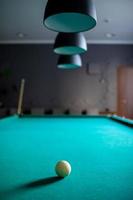
 In the UK in addition to a variety of other British Commonwealth and European international locations, the everyday pool desk is a 7 ft × 3.5 ft (2.1 m × 1.1 m), though 6-foot (1.8 m) tables for the pub and house market are additionally common. These are the sizes used by internationally standardized blackball and the amateur World Eightball Pool Federation, as well as informal pub pool. The World Professional Billiards & Snooker Association Limited. There are solely two sizes authorized for tournament play by World Pool-Billiard Association (WPA): 9 × 4.5 ft and 8 × 4 ft. Two cue balls (initially each white and one marked e.g. with a black dot, but extra just lately one white, one yellow) and a pink object ball are used. Abstract:We study the collision dynamics of a spinning cue ball approaching a static object ball with equal mass on a plane, widespread in billiards. We describe the detailed collision outcomes, emphasizing the importance of contemplating frictions. Instead of considering the issue in a functional sense and iterating approximation procedures, we employ formal power collection strategies and one-by-one straight reconstruct all of the Taylor coefficients of the table. In an effort to show that on an open set Taylor collection diverges we define a Taylor recurrence operator and prove that it has a cone property.
 Since then, a Gevrey regularity for such a billiard was confirmed by Wang and Zhang, but the original drawback about analyticity nonetheless remains open. Abstract:The problem of the existence of an analytic normal form close to an equilibrium level of an space-preserving map and analyticity of the associated coordinate change is a classical drawback in dynamical methods going again to Poincaré and Siegel. To maintain the formal answer distinctive, odd desk derivatives and the normal type are handled as parameters of the problem. 1⁄8-in (51-fifty four mm) balls, and one of these table has smaller, narrow pockets (the width is calculated because the ball diameter multiplied by 1.6, and is consistent at all six pockets), with rounded entrances and almost parallel sides, like these on a snooker table. One tactical consequence of this design distinction is that the jaws of the WPA-kind pocket are often used exactly like a horizontal model of the backboard of a basketball purpose, to rebound the ball into the pocket; this method does not work on blackball tables, and even photographs down the cushion right into a nook pocket are more difficult. On snooker and English billiards tables, the pocket entries are rounded, while pool tables have sharp "knuckles".
English billiards, known as simply billiards in Great Britain, the place it originated, and in many former British colonies equivalent to Australia, is a cue sport for 2 gamers or teams. A drawback of synthetic cloth may be that sure sorts of video games, such as balkline, might lead to damaging the artificial cloth too rapidly due to the way gamers hit the balls. In the case of the pinnacle of billiards excellence, the Diamond Difference shines brilliantly, delivering an unparalleled pool desk experience that captivates players and fanatics alike. English billiards has also, however much less steadily, been referred to as "the English game", "the all-in recreation" and (previously) "the frequent recreation". Some video games, corresponding to English billiards are played on tables as giant as 12 by 6 ft. A billiard table or billiards table is a bounded table on which cue sports are performed. Each player or crew uses a unique cue ball. Points are scored by striking one in all three balls with the cue to contact the other two or one among the two.
The state of the system is given by two numbers: one describing the situation along the curve where the bounce happens, and another describing the incoming angle of the bounce. By uniting the two approaches, we show a number of conjectures on the dynamics of triangle tiling billiards. It is played on a billiards table with the same dimensions as a snooker desk and factors are scored for cannons and pocketing the balls. Reims, France: International Billiards and Snooker Federation. We show specifically that the set for (1) has positive measure (giving a rigorous proof of the existence of Arnol'd tongues for inside-wave billiards), whereas the sets for (2) and (3) are non-empty but have measure zero. Regulation 10 × 5-foot carom billiards tables have a enjoying surface (measured between the noses of the cushions) of 2.84 by 1.Forty two metres (9.Three by 4.7 ft) with a 5-millimetre allowance. All of these conjectures have been stated in print within the last three years. There are six along every long rail (with the facet pocket interfering with the place the seventh one would go, on pocket billiard tables) and three along every short rail, with each of the 4 corners counting as another in the mathematical programs that the diamonds are used to calculate.